Can a single page website rank on Google? The short answer
Yes, a single page website can rank on Google. It will rank for one primary keyword and a small cluster of close variations that share the same intent. It will not rank for many unrelated queries, because every section competes as one URL. That single sentence is the whole of single page website SEO: one page wins one decision, it does not cover a topic.
Here is the position we will defend across this guide: single-page is a campaign format, not a website format. Most one-pagers fail in search because they were treated like a website and asked to do a job that needs ten URLs. No amount of on-page tactics fixes that. The fix is upstream, in the brief.
One URL means one title tag, one meta description, one canonical, and one shot at topical depth. That is a ceiling, not a flaw, as long as your goal fits inside it. Decide the fit first, then optimize.
The single-page builds that rank are the ones pointed at a single search intent: a product launch, an event registration, one focused offer. The ones that fail are catalogs and multi-audience sites wearing a one-page costume. If you want us to make the call on a specific brief, that is what our WordPress and WooCommerce services are for.

What a single page website actually is
A single page website puts all of its content on one URL. Navigation is a set of in-page anchor jumps, #about, #pricing, #contact, that scroll the visitor down the same document instead of loading new pages. One HTML file, one address in the browser bar, start to finish.
That is different from a single page application, which can look identical to a visitor but behaves very differently for a crawler. We separate the two in the next section, because conflating them is the most common mistake in single page website SEO advice.
The format earns its place when one searcher, one keyword cluster, and one action all line up. The briefs where it works look like this: a single-day event or webinar registration, a product launch or single-SKU store, a freelancer or studio portfolio, a SaaS feature or pricing page, and paid-ad landing pages with one conversion goal. In each, a top navigation bar would only be a list of exits.
Here is the tell that you have outgrown the format: the moment your navigation starts pointing to other URLs, you no longer have a single page website. You have a small multi-page site with a long home page, and you should plan it as one.
Single page website vs single page application (SPA)
A single page website is usually static HTML: the content is in the initial response the server sends, so a crawler sees it immediately. A single page application, built with React, Angular, or Vue, ships a near-empty HTML shell and assembles the page with JavaScript in the browser. Same look to a human, very different first impression to Googlebot.
The difference matters because Google renders JavaScript with an evergreen headless Chromium, but it only indexes what ends up in the rendered HTML, and that rendering happens in a second wave after the initial crawl. If your content depends on JavaScript that fails, times out, or never runs for a given bot, that content is effectively invisible. Google’s own JavaScript SEO basics spell this out.
The rendering model decides your risk. Client-side rendering (CSR) is the riskiest for SEO. Server-side rendering (SSR) and static rendering (SSG) put the content in the first response, which is what you want. Prerendering is a partial fix for crawlers.
Skip dynamic rendering. Google now describes it as a workaround, not a long-term solution, and steers you toward server-side or static rendering instead. If a tutorial from a few years ago tells you to detect bots and serve them a different page, it is out of date, and Google says so directly.
For an actual SPA, route with the HTML5 History API and real anchor links, so Googlebot can find your URLs; it only follows <a href> links. Give every view its own title and meta description, and ship an XML sitemap of clean canonical routes. The old #! hashbang AJAX scheme was deprecated in 2015, so do not build on it.
The SEO upside of one URL
The case for going single-page is real, as long as you keep it in proportion.
- Consolidated link equity. Every backlink points at one URL, so authority concentrates on a single address instead of spreading thin across a tree of pages.
- Speed and simplicity. One page, one set of assets, fewer requests. A focused layout is easier to keep fast and easier for a small team to maintain.
- Focused intent. When every section reinforces one keyword cluster, the page does not compete with its own siblings. There is no internal keyword cannibalization, because there are no siblings.
- Low maintenance. One title, one meta, one schema block to keep correct. For a campaign shipping on a deadline, that is a feature.
These benefits are real but modest. They pay off only when the goal genuinely is one intent. They do not buy topical breadth, and no one ever ranked for a hundred keywords by concentrating link equity on one thin page.
The SEO ceiling of one URL
The limits are just as real, and they are why single page website SEO has a hard ceiling.
- One title and one meta description. You optimize for one primary query, not dozens of distinct ones.
- Shallow topical coverage. Search rewards depth across a topic, and one page cannot match the entry points and internal linking of a real site structure.
- Fewer doors in. Anchor sections are not separate pages, so you get one shot at the SERP, not many.
- Harder backlinks. People link to a useful sub-page. On one URL there is no sub-page to link to, which flattens the surface you can earn links against.
- Measurement friction. Without separate URLs you cannot read section performance from pageviews. You have to instrument it.
And the cost almost every guide ignores: a pure single-page store with its policies hidden behind hash anchors can fail payment-processor underwriting outright. That one is important enough to get its own section below.
The one-decision test: one page, many, or hybrid?
Here is the framework we actually run. Ask what the page is for. If it exists to win a single decision, register, buy this one thing, book this call, a single page is correct. If it exists to answer a topic, it is not. Everything else is detail.
Score the brief on five factors: how many keywords you need to rank for, how many distinct intents you are serving, how much content depth the topic demands, how complex the funnel is, and whether you need separate legal or processor pages. Read the dominant column, not a tally.
For most ecommerce, the honest answer is hybrid: a one-page core plus a small set of crawlable supporting URLs. It keeps the conversion focus of a campaign page and the ranking surface of a real site. If you would rather we score a specific brief, send it over.
| Decision factor | Single page (campaign format) | Hybrid (page core + key URLs) | Multi-page site |
|---|---|---|---|
| Target keywords | One primary plus close variations | One core offer plus a growing set | Many distinct keywords across a topic |
| Search intent | One intent, one decision | One core intent plus supporting intents | Multiple, often unrelated intents |
| Content depth | Shallow and focused | Focused core, deepening over time | Deep topical coverage |
| Funnel complexity | One conversion goal | One goal plus nurture content | Multiple paths and stages |
| Processor / legal pages | Fails if you take payments (hash-only policies) | Separate Terms, Privacy, Refund, Shipping, Contact | Built in by default |
| Backlink surface | One URL, harder to earn topic links | Core URL plus linkable supporting pages | Many linkable pages |
| Indexable URLs | One (anchors are not separate pages) | A handful of real URLs | Many |
| Best-fit examples | Event registration, single-SKU launch, paid-ad landing, portfolio | Single-SKU brand that blogs and sells | Catalog ecommerce, multi-location brands |
| SEO ceiling | Low: one title, one meta, one shot | Medium and rising | High |
Anchor links, hash fragments, and what Google indexes
The most expensive misconception in single page website SEO is that #section anchors are separate, rankable URLs. They are not. Google does not treat URL fragments as distinct URLs, and it does not index #pricing or #faq as their own pages. Google Search Central is explicit about it.
So all of your content competes as one URL. You cannot win one ranking for pricing and a second for your FAQ the way two separate pages could. You get one title, one meta, one entry in the index.
Do not use fragments to load different content either; that simply does not work with Googlebot. If you need genuinely distinct views, use the History API and real links, not the URL hash. One more trap: a canonical URL must not contain a fragment, because Google does not support fragments as canonicals. If your one-pager auto-generates canonicals with a # in them, fix that.
In-page anchors are still good UX, and they can earn jump-to-section links in some snippets. Just do not expect them to rank on their own. And if any guide tells you to use the #! hashbang scheme, close the tab; Google deprecated it in 2015.
Core Web Vitals on one very long page
A single page lives or dies on speed, because all of its weight loads against one URL. The current Core Web Vitals, measured at the 75th percentile, are Largest Contentful Paint within 2.5 seconds, Interaction to Next Paint at or below 200 milliseconds, and Cumulative Layout Shift at or below 0.1. Those numbers come straight from web.dev.
If your advice still mentions First Input Delay, it is dated. INP replaced FID as a Core Web Vital on March 12, 2024.
LCP. On a one-pager the hero is almost always the LCP element. Preload it, serve it as WebP or AVIF, and keep render-blocking resources out of the way above the fold.
CLS. Long pages have a specific layout-shift problem: sections that lazy-load as the visitor scrolls shift the content under them. Reserve space with explicit width, height, and aspect-ratio so later sections never push things around.
INP. Responsiveness suffers when scroll-triggered animation and per-section JavaScript pile up on the main thread. Defer non-critical scripts and keep the work small. Two upstream choices matter more than any micro-fix: a host that is actually fast, and a builder that does not wrap every section in four nested divs.
The on-page playbook for one URL
Once the architecture is right, the on-page work for single page website SEO is disciplined, not complicated.
- One H1, sectioned H2s. Put the primary keyword in the H1, then map each H2 to a sub-intent and to the questions people actually ask. Clean section headings also help AI systems extract passages.
- One sub-intent per section. Give each section a job so the page reads as an argument, not a keyword pile. Repetitive, thin sections are how one-pagers get flagged for keyword stuffing.
- Title and meta for the one query. Keep the title near 60 characters and the description near 155, and write them to earn the click, not just to contain the keyword.
- Schema you can defend. You can stack types on one URL, Organization, Product, FAQ, Review, LocalBusiness, where each is genuinely present. Do not mark up content that is not on the page.
- Images done right. Descriptive alt text, compression, modern formats, and lazy-loading below the fold. Never lazy-load the hero; it is your LCP.
- Content in the HTML. Tabs and accordions can be indexed if the content sits in the rendered DOM, not injected only after a click. Default-visible is the safer practice; Google only indexes what is in the rendered HTML.
Most of this overlaps with how we build everything. The same discipline lives in our WordPress best practices.
The ecommerce trap most guides skip: processor-required legal URLs
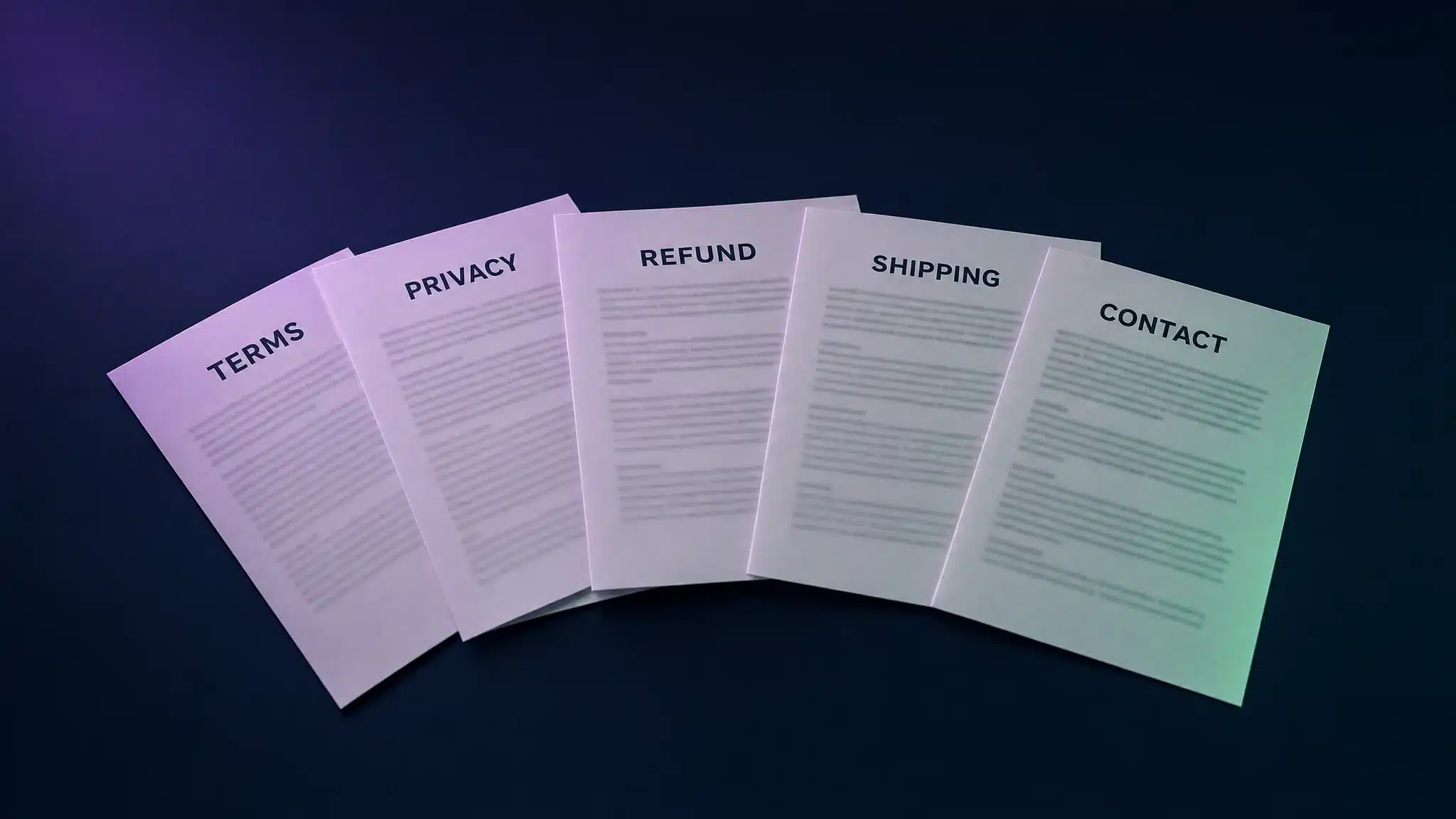
Here is the one nobody else writing about single page website SEO seems to mention. Payment processors and merchant underwriters often require distinct, crawlable URLs for your Terms, Privacy Policy, Refund or Return Policy, Shipping Policy, and Contact details. Not a modal. Not a #terms anchor. Real pages with real addresses.
A pure single-page store that buries those behind hash anchors can fail underwriting review. For an ordinary store that is a delay. For anything a processor treats as higher risk, it can be the difference between a live merchant account and a rejected application.
So the moment you take payments, you are not really on one page anymore. Each policy needs its own indexable address, for example /refund-policy, which by definition pushes you to a hybrid architecture.
For any business that takes payments online, this requirement usually decides the architecture before SEO gets a vote. The same logic shows up wherever trust depends on a stable address rather than a scroll. Plan the separate legal pages from day one; retrofitting them after a rejection costs you the launch window.
Backlinks, AI Overviews, local, and analytics on one URL
One URL changes how you earn links. With no sub-pages to attract topic-specific links, you lean on digital PR, journalist requests, and reclaiming unlinked brand mentions. The link target is always the same address, which at least keeps your equity concentrated.
AI Overviews and AI Mode need no special treatment. Google states there is no extra markup or optimization required beyond being indexed and meeting Search’s technical requirements, and AI-feature traffic shows up in Search Console under the Web type. Google’s AI features guidance is clear on this. A single, well-structured page can be cited at the passage level, which is one more reason clean section headings pay off.
For a local one-pager, keep your name, address, and phone consistent, add LocalBusiness schema, align the page with your Google Business Profile, and use the location in the copy. One page can rank for a focused service area, the same way a single-location service site ranks for its town.
Because you have no separate URLs, instrument the page: GA4 events and scroll-depth tracking, and optional virtual pageviews for hash sections, so you can read which section actually converts. One URL does not exempt you from measuring; it just means you have to set the measurement up.
When to graduate to multi-page (without losing rankings)
Split the page when any of these is true: you are targeting genuinely different intents, the content has outgrown what one title can represent, you keep wanting to publish, or you need processor legal pages. Those are signals the campaign format has done its job.
Most teams should not jump straight to a full rebuild. Add a /blog subfolder and a few key supporting pages first, keep the campaign page as the conversion core, and link between them. That is the hybrid pattern again, reached from the other direction.
When you do split one URL into many, the redirect map is the deliverable that keeps your rankings. Map the old anchor sections to their new URLs and 301 the old address so the equity you concentrated flows to the right pages instead of evaporating. We have written the full redirect-map playbook separately.
Keep the single page where it earns its keep, as a campaign asset aimed at one decision, and build real structure for everything that needs to rank across a topic. If you want a straight answer on which one your brief needs, send it to us; we will tell you which architecture fits, and where you would be better served hiring someone cheaper.