The research peptide market has grown into one of the most demanding ecommerce verticals to operate well. The audience is technically literate. The regulatory environment is unforgiving. Mainstream payment processors won’t touch the vertical. And most off-the-shelf ecommerce platforms weren’t built for any of it. If you’re a founder evaluating a launch, or an existing brand planning a rebuild, the build decisions you make in the first 90 days will determine whether the next twelve months are about growth or about firefighting.
We’ve built and still maintain WooCommerce peptide stores for brands across the US and Canada. This is the practitioner’s version of what it actually takes to launch a research peptide ecommerce store properly in 2026. If you would rather have it built and maintained for you, see our peptide website development service.

The four jobs a research peptide store has to do well
Before platform decisions, get clear on what the store actually has to deliver.
1. Credibility at first contact
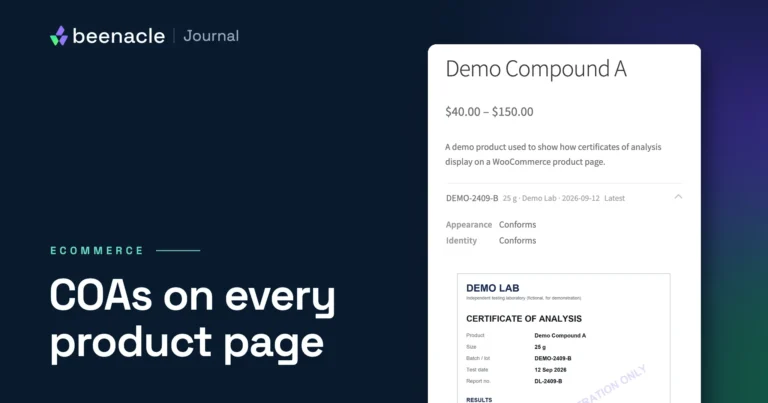
Sophisticated buyers decide within ten seconds of landing whether the brand is real or fly-by-night. COAs visible from product pages, real company info, third-party lab verification, real lot tracking.
2. Frictionless purchase for repeat customers
Most research peptide revenue comes from repeat purchases. The cart-to-checkout flow has to be fast, trusted, and not break the customer’s working pattern.
3. Compliant content and product information
Product pages have to communicate technical information clearly while staying within the research-only framing required by regulators and payment processors.
4. Operational efficiency for the team running it
Order management, lot tracking, COA distribution, shipping logistics, customer service. The platform that wins is the one your team can operate without constant developer help.
Why WooCommerce, and why not Shopify
The platform question gets asked a lot. The short answer for the research peptide vertical in 2026 is WooCommerce, and the reasons are specific to the vertical.
Payment processor flexibility. Shopify Payments and most mainstream Shopify-compatible processors will not work with peptide ecommerce. WooCommerce, being open, lets you wire in the high-risk merchant processors that actually serve the vertical.
No platform-level content moderation risk. Shopify reserves the right to suspend stores in industries it deems “high risk.” We’ve watched brands lose Shopify stores overnight after years of clean operation. WooCommerce is self-hosted. There’s no platform with that power over your business.
Complete control over product page architecture. COAs, lot information, compound details, research disclaimers, schema markup. WooCommerce gives you full HTML and PHP control.
Cost scaling. Shopify Plus starts around $2,300/month. A well-built WooCommerce store on Kinsta runs $35–200/month all-in. For a brand doing seven figures, the savings compound.
| Factor | WooCommerce on Kinsta | Shopify / Shopify Plus |
|---|---|---|
| Monthly platform cost | $35–200 a month | Shopify Plus from $2,300 a month |
| High-risk payment processors | Connect almost any processor | Limited; Shopify Payments blocks the category |
| Suspension risk for peptides | You own the store and the data | Account can be frozen with little notice |
| Customization control | Full code and template control | Constrained by platform rules |
| COA and lot-tracking flexibility | Fully customizable | Workarounds and paid apps |
| Who carries the risk | You do, with redundancy you control | The platform decides what stays live |
The stack we’d deploy for you
The default stack we deploy on new research peptide ecommerce builds in 2026:
- Hosting: Kinsta, in your own account, on a plan sized to your traffic. Managed WordPress on Google Cloud, daily backups, server-level security.
- Page builder: Bricks. Cleaner code, faster page loads than Elementor.
- Ecommerce: WooCommerce + Subscriptions + Memberships (if relevant).
- Payment processing: High-risk specialists. NMI gateway, eMerchantBroker, Durango Merchant Services.
- Crypto as backup: BTCPay Server or NOWPayments for when card processing is interrupted.
- Shipping: ShipStation or EasyPost.
- Email: Omnisend or Customer.io (Klaviyo won’t serve the vertical).
- Analytics: GA4 + server-side via Stape.
- Reviews: Judge.me or Stamped.io.
The payment-processing problem
Payment processing is the single hardest operational problem in research peptide ecommerce. Worth addressing in detail because most founders underestimate it.
You will need a high-risk merchant account. Standard processors (Stripe, Square, PayPal) will either not approve you, or approve you and then close the account 30–90 days later when their compliance team reviews.
Processing fees will be 4–6% of gross. Versus 2.9% + 30¢ on standard commerce. On a $100,000 monthly revenue store, that’s $1,100–3,100/month more in processing fees.
Underwriting takes 2–6 weeks. You can’t launch and figure out payment processing later. Start the application before the store is finished.
Maintain two processors in parallel. Even high-risk specialists sometimes cut accounts without warning. Successful brands route traffic to the working one if the primary is interrupted.

COA management and lot tracking
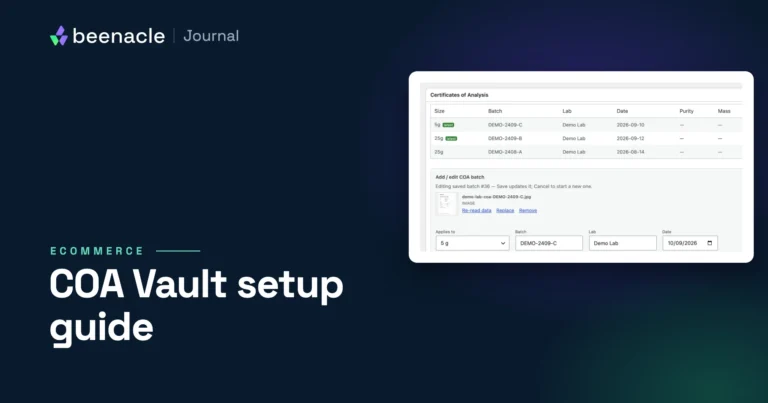
A research peptide store without traceable COAs is a store that loses serious buyers immediately. The right setup:
- One COA per lot. Each product page references the current lot’s COA, accessible via a direct link.
- Lot rotation built into the product page. As lots rotate, the product page automatically reflects the current lot and its COA via a custom CPT.
- Third-party verification on top. An independent lab verification adds a trust layer. Worth the $30–60 per lot.
- Storage and handling instructions per product. Temperature requirements and shelf life.

Compliance and labeling fundamentals
The short answer: research peptides are sold in the US for laboratory use, and how they’re labeled and marketed matters as much as what’s in the vial. At a minimum that means research-use-only language, no human-consumption claims, 18+ verification, and restricted-state shipping handled.
Disclaimer: this is general guidance based on what we’ve seen work for clients. It is not legal advice. Engage a regulatory attorney familiar with your jurisdiction before launch.
The baseline expected for US research peptide ecommerce:
- Clear “For research purposes only. Not for human consumption.” labeling on every product page, in cart, at checkout, on shipping packaging.
- No therapeutic claims anywhere on the site, in any content, in any email, in any social media.
- Clear age verification (18+ minimum) and acceptance of research-only terms before purchase.
- Restrictions on shipping to states or countries where regulations are stricter.
SEO setup from day one
Most research peptide brands launch with weak SEO foundations and try to retrofit later. It costs them years. The baseline we recommend for every store:
- Schema markup for every product (Product with Offer, AggregateRating, Brand).
- Category architecture by research area rather than by chemistry family, with category names that make no health claims.
- 600–1,200 words of product page content per SKU.
- Compound family hub pages: long-form 2,000+ word pages that rank for the head terms.
- Internal linking discipline so every product links to its hub and every hub links to variants.
- Performance budget: LCP < 2s (well inside Google’s 2.5s “good” threshold), INP < 200ms, CLS < 0.1.
What this costs in 2026
Realistic ranges for a credible research peptide WooCommerce launch:
| Component | Typical 2026 cost |
|---|---|
| High-Risk Store Launch (fixed scope, any catalog size) | $12,000 |
| Custom build (lot-level inventory, several processors or markets, ERP or 3PL) | from $15,000, quoted |
| Hosting, billed by Kinsta | about $35–200 a month depending on traffic |
| Bricks license (one-time) | $249 |
| WooCommerce plugins (annual) | $800–1,500 |
| High-risk merchant setup | $300–1,000 + 4–6% |
| Legal review by your own counsel (not a Beenacle service) | $2,000–8,000 |
| Care plan (High-Risk Store Care, from day 31) | $750/month |
Timeline: the High-Risk Store Launch is ready to launch in six weeks; card-processor approval timing and the decision stay with the processor. Custom builds run 8–14 weeks from kickoff to launch; more than 14 usually means scope sprawl.
The first 90 days post-launch
A research peptide store doesn’t get to coast post-launch. The first 90 days set the trajectory.
Days 1–30
Monitor checkout completion rates obsessively. Watch for payment-processor decline patterns. Verify shipping integration. Fix the obvious issues fast.
Days 31–60
Begin SEO content build-out. Compound hub pages, comparison content, methodology guides. The flywheel that the next two years run on.
Days 61–90
Email automation. Cart-abandonment flows, post-purchase review request flows, lapsed-customer reactivation.
Common mistakes that kill new peptide stores
- Using mainstream payment processing at launch. Stripe will typically approve you, accept transactions for 30–90 days, then close the account once compliance reviews it.
- Thin product pages. 100 words of description plus a price is a page that doesn’t rank and doesn’t convert.
- No COA visibility. A store that hides or doesn’t display COAs reads as not legitimate.
- Making therapeutic claims, anywhere. One slip can cost you the merchant account and trigger regulatory attention.
- Picking a generalist agency. Most don’t understand the vertical’s payment, compliance, and content constraints.
- Underinvesting in customer service. Research peptide buyers ask technical questions. CS that can’t answer them kills the brand.
The bottom line
A research peptide store is one of the most demanding ecommerce verticals to build, and one of the most rewarding when it’s done right. Customer LTV is high, repeat purchase rates climb fast, and competition stays thin because most operators avoid the technical and compliance load.
We’ve built and still maintain research peptide WooCommerce stores for brands across North America. If you’re evaluating a launch, planning a rebuild, or weighing your platform decision, send us a brief. We’ll come back within one business day with an honest assessment.